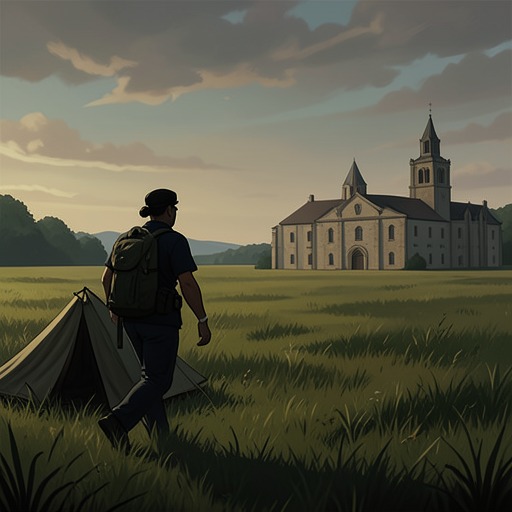
Goldmund is expelled from the knight’s household
Narcissus and GoldmundGoldmund is expelled from the knight’s household after a nighttime confrontation between Lydia and Julie makes his intimate involvement with the sisters impossible to conceal. The expulsion ends his life under the knight’s roof and sends him back to the wandering existence he had once imagined choosing for himself. Its meaning deepens in retrospect: amid the plague and anti-Jewish violence, Goldmund encounters Rebekka, whose grief and accusation force him to recognize how easily his offers of help can reproduce the harm and entitlement of the world around him.
The confrontation and its disclosure
On the first snowy day of winter, Lydia comes to Goldmund’s room at night, as she customarily does. She is troubled by fear that Julie may betray their secret, but does not tell Goldmund what is weighing on her. Their private intimacy is interrupted when Julie enters. Lydia, startled, clings to Goldmund; Julie makes clear that she will either be admitted to the bed or wake her father. Goldmund lets her in, and the three remain together in the narrow bed.
The moment brings Goldmund’s hidden desire into the open without resolving the sisters’ relationship. When Lydia hears Julie respond to his attention, she abruptly ends the encounter and tells Julie to leave with her. Goldmund, feeling rejected, turns toward Julie and asks her to meet him the following day. Lydia nevertheless helps her sister on the way out, placing Julie’s coat around her. That gesture both conveys Lydia’s distress and touches Julie, briefly reconciling the sisters even as the encounter has set them against one another.
The confrontation continues in its aftermath. The sisters return to their room without speaking and lie awake separately. Lydia spends the remainder of the night in distress, then kneels in prayer before the small wooden Saviour in her room. In the morning she tells the knight what she has decided to disclose, but does not mention Julie’s part. Her account is enough to bring the secret to the household’s authority: Goldmund finds the knight dressed for the outdoors rather than for their usual writing, and understands that he is being taken away.
The knight’s sentence and Goldmund’s departure
At dawn, the knight leads Goldmund down the stairs, across the courtyard, and out through the gate. The snow underfoot is slightly frozen, and the sky is red, but the two men walk in silence. Goldmund looks back at the house, his room’s window, and the steep snow-covered roof as they disappear from view. The departure is painful precisely because the household has become more than a place of shelter: he must leave the study, the bedroom, and the two sisters all at once.
After about an hour, the knight stops and tells Goldmund to continue alone in the same direction, returning to the wanderer’s life he had led before. He says that if Goldmund ever appears again near his house, he will be killed. The threat is conditional, not an attempt to pursue him immediately; the knight says he does not wish to take revenge, but admits he should not have allowed such a young man to live intimately with his daughters. He ends by telling Goldmund to go and asking God to forgive him.
The knight remains where he is until Goldmund has disappeared over the next ridge. The dawn’s reddish light fades, the sun does not appear, and snow begins to fall. The visual separation seals the expulsion: Goldmund’s imagined sudden departure has become an imposed one, governed by the knight’s warning and accompanied by the loss of the home he has formed there.
The plague road and Rebekka
The expulsion returns Goldmund to wandering, a life that later carries him through regions devastated by plague. He encounters abandoned homes, unburied dead, starving animals, and survivors driven by fear. The epidemic also fuels accusations against supposed sources of infection. In one town, Goldmund watches a mob burn the entire Jewish ghetto, driving people back into the fire; he is appalled by the killing of innocent people and by the search for scapegoats amid general suffering.
Outside a small town, he finds Rebekka mourning beside rubble. Her father has been burned with fourteen other Jews on the town authorities’ orders. Rebekka had escaped, but returned in despair, blaming herself for not having died with the others. Goldmund helps her gather her father’s bones from the ashes and bury them in a hidden place in a field. He then offers to protect her and asks her to travel with him, promising not to touch her until she is ready.
Rebekka rejects the offer. She accuses Christians of first helping a daughter bury the father their people murdered and then expecting the daughter to belong to them. Goldmund recognizes that his attempt to move her from grief toward companionship has repeated, in another form, the assumption that her needs should yield to his wishes. He admits that she may be right and asks forgiveness. The encounter complicates the moral aftermath of his expulsion: wandering exposes him not only to mortality and violence, but to the obligation to see the person before him rather than turn suffering into an occasion for his own desire or consoling story.
Retelling and significance
Later, Narcissus asks Goldmund whether he witnessed Jews being burned and whether he prevented it. Goldmund answers that he did not, and then tells Narcissus Rebekka’s story in detail, growing heated as he speaks. He asks whether the world in which people are made to live is hellish and revolting; Narcissus agrees that the world is indeed like that. The exchange sets Goldmund’s helpless witness beside his act of assistance to Rebekka: he could not stop the violence, but he could help bury her father and listen to her condemnation.
The expulsion’s immediate cause is a household secret disclosed by Lydia, while its immediate consequence is Goldmund’s renewed homelessness under threat of death if he returns. The later plague episodes do not undo that separation; instead, they widen its significance. The knight’s order sends Goldmund into a world where private desire, bereavement, prejudice, and violence repeatedly collide, and where even a well-meant offer must be measured against the suffering of the person receiving it.